
Before Dollar One: California’s Funding Letter Misses the First Question
Author, Breaking the Bell™ | Founder, The Next Chapter™
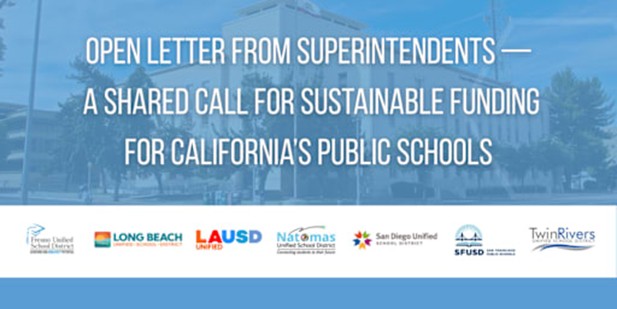
Before Dollar One:
California’s Funding Letter Misses the First Question
Manuel Ferrer, Ed.D.
California superintendents are asking for “stable, adequate, predictable” funding as enrollment declines, federal relief ends, and costs rise. That concern is real. The cost pressure is real. The letter reflects that.
But the first conversation is still not funding.
It is trust.
And right now, trust is the currency public systems have bankrupted.
That is not a partisan line. It is the unavoidable conclusion a taxpayer reaches when they keep seeing the same pattern across government systems: more money requested, weak controls, poor results, and then another ask.
A balanced view still allows moral clarity
You can respect the difficulty of running large systems and still be disgusted by what has happened.
You can support public education and still say this plainly.
When money intended for children, elders, and vulnerable families is mismanaged or stolen, it is not a bookkeeping issue. It is a betrayal. It is a crime against our own people.
That is why the public hesitation is not irrational. It is earned.
The broader pattern is why the trust problem comes first
This is bigger than schools. That is the point.
1) Minnesota, child nutrition fraud
Federal prosecutors described the Feeding Our Future schemeas a roughly $250 million fraud involving funds intended to feed children, and a federal jury convicted key defendants in 2025.
2) California, hospice fraud crackdown
California reported in January 2026 that it has revoked more than 280 hospice licenses since the state’s provider ban took effect, as part of a fraud crackdown. (gov.ca.gov)
3) Los Angeles County concentration in home health and hospice billing
Reporting has highlighted that Los Angeles County accounts for about 18% of the nation’s home health and hospice Medicare billing activity, which is exactly the kind of concentration that should trigger serious public scrutiny. (hospicenews.com)
When these kinds of failures happen in services meant for children and end-of-life care, the public is not wrong to ask whether leaders were incompetent, complicit, or both.
Now bring it back to education
This is where the open letter gets the sequencing wrong.
The message is essentially: costs are up, so funding must go up.
But parents and taxpayers are also looking at outcomes.
Using 2025 CAASPP district results, Los Angeles Unified reports:
- ELA (met/exceeded): 46.45%
- Math (met/exceeded): 36.76% (data reviewed from district CAASPP reporting)
That means in LAUSD, more than half of students are not meeting standard in ELA, and nearly two-thirds are not meeting standard in math.
San Diego Unified performs better, but the math story is still hard to celebrate:
- San Diego remains under 50% proficient in math (about 45% meeting/exceeding based on district results reviewed)
On NAEP, the national benchmark that gives a broader comparison lens, Los Angeles Grade 4 math shows only 27% at or above NAEP Proficient in 2024, and Los Angeles Grade 4 reading averaged 206 in 2024.
That does not mean educators are not working hard. Many are doing extraordinary work.
It means the system-level claim, “give us more and outcomes will improve,” no longer carries automatic credibility.
The federal proof point no one wants to confront
If we are being honest, this debate is bigger than California.
The modern U.S. Department of Education was created by Congress in 1979 and began operations in May 1980.
Since then, the country has spent enormous sums across federal, state, and local education systems, including billions in federal education spending year after year. That is not controversial. It is the baseline reality.
And yet the long-run academic story is not one of steady national improvement.
NAEP’s Long-Term Trend assessment, the most consistent national benchmark we have across decades, shows a much more sobering picture. For example, NCES reports that 9-year-old reading and math scores in 2022 were higher than the earliest assessments in the 1970s, but lower than the prior assessment in 2020, including a 5-point drop in reading and a 7-point drop in math from 2020 to 2022.
That matters because it undercuts the lazy assumption that higher spending automatically produces better outcomes.
More money can help. It can fund staffing, curriculum, tutoring, transportation, and recovery efforts.
But more money alone does not guarantee better results. Not nationally. Not systemically. Not automatically.
If it did, we would not still be arguing over stagnant outcomes after decades of spending growth.
At some point, adults have to say what families already know.
Throwing more money into weak systems without structural accountability is not compassion. It is negligence.
The Mississippi contrast California does not want to explain
And then there is the comparison that should make policymakers deeply uncomfortable.
In 2024 NAEP Grade 4 Reading, Mississippi scored 219, while California scored 212. Mississippi was above the national average of 214. California was not.
In 2024 NAEP Grade 4 Math, Mississippi scored 239, while California scored 233. Mississippi again outperformed California. (NCES state snapshot reports.)
Now add the spending context.
Using NCES FY 2022 current expenditures per pupil:
- California: $16,739
- Mississippi: $11,085
That means California spends $5,654 more per student, or about 51.0% more per pupil than Mississippi.
Yet Mississippi still outscored California on NAEP Grade 4 results, by 7 points in reading (219 vs. 212) and 6 points in math (239 vs. 233). Put another way, Mississippi scored about 3.3% higher in reading and 2.6% higher in math, despite California spending roughly 51% more per pupil.
That comparison is not meant to romanticize one state or reduce education to one test.
It is meant to force the right question.
If a state spending substantially less per pupil can post stronger results in key early literacy and math benchmarks, then the conversation cannot stay trapped at “we need more money.”
The conversation has to move to instruction, accountability, leadership, implementation, and system design.
Not whether we can spend more, but whether we can produce more.
The megaplex model is the deeper issue
Traditional district megaplexes were built for a different era.
Bigger central offices, more layers, more complexity, more process.
The pandemic accelerated what many families already suspected. Learning can be organized differently. Support can be delivered differently. Accountability can be tighter, more local, and more visible.
This was not a temporary disruption. It was an evolutionary event.
Trying to preserve an archaic system by feeding it more money, without structural reform, is not strategy. It is institutional self-preservation.
Before any new funding ask, require measurable gains
This is where public policy has to grow up.
Before dollar one in new funding, there should be ironclad structural reforms that lead with accountability, not dogma.
And yes, it is time to require measurable academic gains before we keep throwing good money after bad.
Not overnight miracles. Not gimmicks. Real, transparent improvement in reading and math.
At minimum:
- Public-facing financial transparency that normal people can understand
- Independent audits with consequences, not recommendations
- Fraud controls designed for reality, not trust-based assumptions
- Clear spend-to-outcome reporting at the school and district level
- Performance conditions tied to new funding, including measurable gains in reading and math
- Smaller, locally accountable operating structures where responsibility is visible
- Operational redesign across pedagogy, services, safety, procurement, and finance controls
If leaders want the public to fund the next chapter, they have to prove they can steward the current one.
The uncomfortable but necessary conclusion
I am not anti-public education.
Quite the contrary, I am pro-public trust.
And right now, the trust account is overdrawn.
So the response to any new funding ask is not “never.”
It is this:
Not before accountability. Not before results.
Protect the dollars. Prove the gains. Earn trust. Then ask.
About the Author
Manuel “Dr. Manny” Ferrer, Ed.D., is an educator, former school leader, and entrepreneur whose work sits at the intersection of education, systems design, and accountability. A recipient of the Chappie James Most Promising Teacher Award and a two-time Teacher of the Year, he began his career in public education and later transitioned into leadership roles across education and the private sector.
Dr. Manny writes and speaks about public trust, institutional performance, and the future of education, with a focus on what happens when systems drift from outcomes and accountability. His perspective is shaped by lived experience in classrooms, school leadership, and education-focused business environments, where he has worked on both sides of the funding and results conversation.
He is the author of Breaking the Bell™ and The Hybrid Seller™, and his work consistently challenges leaders to move beyond rhetoric and redesign systems around trust, transparency, and measurable results.


More Articles
All Articles
Measures against rising rape figures in Oslo

What is online sexual violence and how to prevent it from happening?

How to be more aware of sexual assault before it happens





Pages
Contacts
